Motorists, households and airlines will get some relief this month after the Malawi Energy Regulatory Authority (Mera) cut prices for diesel, kerosene and Jet A-1 effective August 1 2026. Petrol remains unchanged.
Under the new rates, diesel drops by 7.03 percent to K5 863 per litre from K6 306. Kerosene falls by eight percent to K4 389 from K4 771. Petrol stays at K5 619 per litre.

Jet A-1 also dropped by six percent to K4 577 at Kamuzu International Airport (KIA) and five percent to K4 496 at Bakili Muluzi International Airport (BMIA).
Transporters and consumers welcomed the cuts, but called for the benefits to be passed on.
Minibus Owners Association of Malawi (MOA) president Coxly Kamange said the reduction should reflect in transport fares.
“We are scheduled to meet the Minister of Transport to discuss the way forward and encourage operators to adjust fares accordingly,” Kamange said.
Transporters Association of Malawi spokesperson Frank Banda described the fuel cuts as “an important step towards reducing transport costs.”
“Many transporters have been operating at a loss. With this adjustment we expect fuel costs to decline,” Banda said.
Consumers Association of Malawi (Cama) executive director John Kapito said consumers now expect lower prices for goods and services.
“This is the second fuel price reduction in a few months, and it should be reflected in the prices of commodities,” Kapito said.
Mzuzu University economist Christopher Mbukwa said the cuts, though modest, will help.
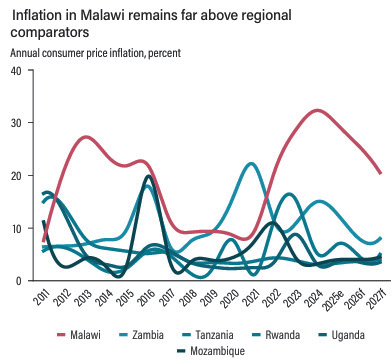
“Diesel is a key driver of economic activity. Over time, the reduction could help ease production and transport costs and contribute to slowing inflation,” Mbukwa said.
Mera said the adjustments were made under the Automatic Pricing Mechanism (APM) following recommendations from its Energy Pricing Committee.
The cuts were triggered by a decline in average Free on Board (FOB) prices since the last review on June 19 2026, plus changes in freight, insurance, taxes and the In-Bond Landed Cost (IBLC).
For Jet A-1, Mera said the In-Bond Landed Cost decreased at both KIA and BMIA in July due to lower FOB prices and freight costs.
Because the decrease was outside the ±5% APM trigger band, a downward revision was applied.
Malawi reinstated APM in January 2026 after three years of a fixed pricing regime. Mera argues the fixed regime was “commercially unsustainable,” causing fuel shortages, trading losses, failure to remit Road and Rural Electrification levies, and fuel smuggling that depleted strategic reserves.
Under APM, Mera reviews prices monthly. An adjustment is triggered when key parameters—FOB prices, freight, exchange rate, insurance and levies—move by more than ± five percent.
Malawians have seen major volatility. In October 2025 petrol was K3 499 and diesel K3 500 per litre. APM triggered a 41 percent hike in January 2026, followed by another jump in February to K6 672 for petrol and K6 687 for diesel. Kerosene peaked at K5 824.
Prices eased in June, and the latest review continues the downward trend for diesel and kerosene.
Even so, petrol is still about 60 percent higher and diesel about 67 percent higher than in October last year.
Mera notes global oil prices have eased from around $110 to $73 per barrel, but a weak kwacha continues to push landed costs up.
The authority says it will keep monitoring markets, noting that geopolitical conflict in the Middle East continues to affect world petroleum prices.